
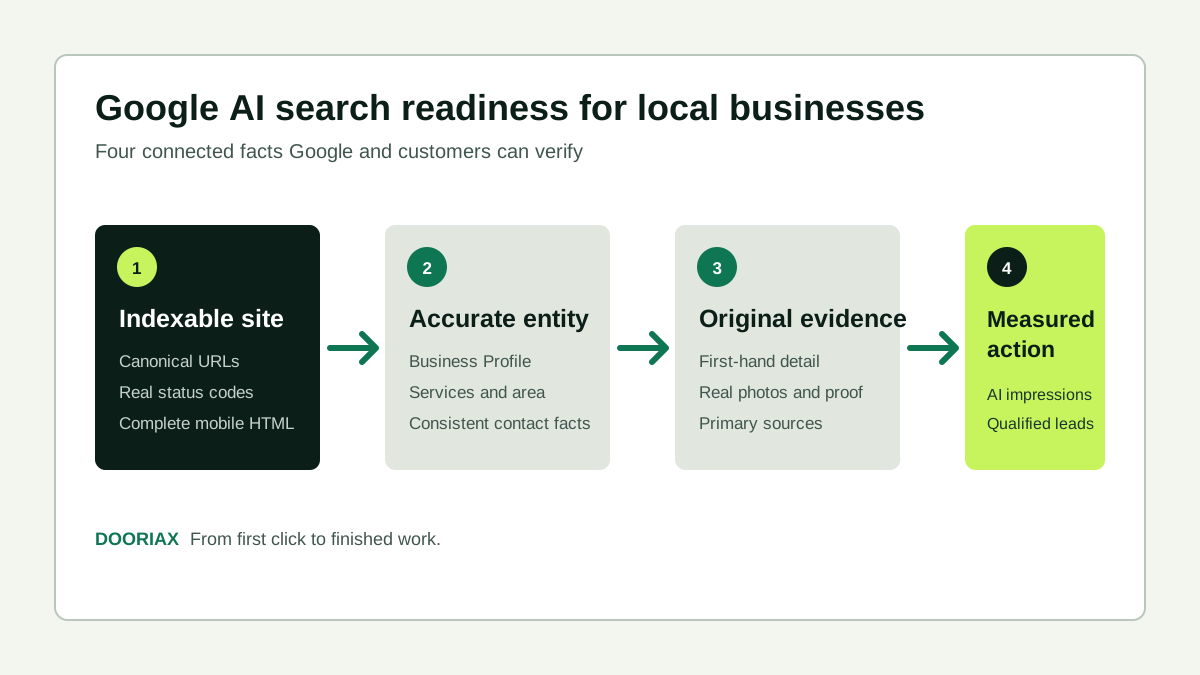
Is SEO still relevant for Google AI Overviews and AI Mode?
Yes. Google states that its generative AI features use core Search ranking and quality systems. Retrieval-augmented generation finds current pages in the Search index, while query fan-out issues several related searches to gather enough information for a useful response.
The practical consequence is simple: a page cannot support a grounded Google AI answer unless Google can crawl it, index it, and show it with a normal Search snippet. Meeting those requirements does not guarantee selection, but missing them prevents eligibility.
What content gives a local business something worth retrieving?
Google recommends unique, non-commodity content created from real knowledge and experience. A local business should publish information only it can provide: how it evaluates a job, what customers should prepare, which constraints change the recommendation, what the service includes, how the process works, and what evidence supports the claims.
Useful evidence by service model
- HVAC, plumbing, roofing, and electrical: real service process, equipment context, safety boundaries, scheduling facts, original project photography, and verified credentials.
- Lawn care and pest control: season, property conditions, route limits, recurring-service process, preparation instructions, and current service-area facts.
- Restaurants: current menu, prices, hours, reservation or ordering links, accessibility information, and original food and location photography.
- Massage and wellness: verified practitioner credentials, service format, pricing context, booking expectations, and responsible language that avoids unsupported medical claims.
Generic articles that repeat common advice add little. Publish a page when it helps a real customer make a distinct decision, not because a keyword tool produced another variation.
Which technical requirements control Google AI eligibility?
Technical clarity makes the same page understandable to customers, Googlebot, and browser agents. The primary content should arrive in the HTML, remain visible on mobile, and use consistent metadata and structured data where appropriate.
| Requirement | What good implementation looks like | Failure to avoid |
|---|---|---|
| Crawlability | Googlebot can load the page, CSS, JavaScript, images, and internal links without a challenge. | Blocking required resources or serving an empty client-only page. |
| Indexability | The page returns 200, permits indexing, has useful content, and is included in a valid sitemap. | Noindex mistakes, soft 404s, or pages that add no distinct value. |
| Canonicalization | One preferred HTTPS URL is used in canonicals, internal links, sitemaps, and redirects. | Duplicate hostnames, slash variants, parameters, or conflicting canonicals. |
| Mobile experience | Mobile users receive the same main content, links, metadata, images, and schema in a fast readable layout. | Hiding important information behind desktop-only components. |
| Status codes | Moved pages redirect permanently and missing pages return a true 404 or 410. | Returning a 200 page for every unknown URL. |
| Page experience | The main content is easy to identify, controls work, text remains readable, and latency stays low. | Intrusive overlays, unstable layouts, or heavy scripts before content. |
How does Google Business Profile support local AI visibility?
Google says Business Profile details can appear in AI responses and regular Search. A service-area business should keep the public name, primary category, services, phone, website, hours, service area, booking links, photos, and reviews accurate. If customers do not visit the address, the verification address should remain hidden.
The website and profile should describe the same business. Conflicting categories, phone numbers, locations, or customer types create an entity problem that another article cannot repair.
Which AEO and GEO tactics does Google say to ignore?
Google's current guide explicitly rejects several popular shortcuts for its own Search features.
- Special AI files: Google ignores llms.txt and similar files for Search ranking. They may serve other agents, but they do not improve Google visibility.
- Artificial chunking: there is no requirement to split coherent content into tiny passages for Google AI.
- Separate AI rewrites: Google understands synonyms and meaning. A business does not need a page for every long-tail phrasing.
- Inauthentic mentions: fake reviews, planted forum posts, and manufactured citations are not durable authority.
- Schema overfocus: structured data remains useful for eligible rich results, but it is not required for AI Overviews or AI Mode.
How should local businesses measure Google AI visibility?
Google says its Generative AI performance report rolled out to websites worldwide on August 31, 2026. It reports impressions from AI Overviews and AI Mode by page, country, date, and device. A site may not see data if it has too few impressions or has excluded itself from Google's generative AI features.
AI impressions are an eligibility and visibility signal, not a completed business outcome. Review them alongside branded searches, landing-page actions, calls, forms, booking requests, self-reported attribution, lead qualification, and completed work. Dooriax forms include an optional question asking how the person first discovered the brand because AI research often produces a later branded or direct visit.
A practical Google AI search checklist.
- Confirm eligibility. Inspect priority pages in Search Console and confirm the intended canonical is indexed.
- Remove duplicate paths. Redirect unused hostnames and URL variants to one preferred address.
- Review the mobile page. Confirm the main copy, links, images, forms, and metadata remain complete and usable.
- Strengthen original evidence. Add real process detail, approved examples, named primary sources, and original media.
- Align the local entity. Make the website and Business Profile agree on name, phone, service area, categories, services, hours, and customer type.
- Improve internal discovery. Link related guides, services, industries, and the next customer action with descriptive anchor text.
- Measure the right report. Review the Generative AI report when available and compare changes over several weeks, not several hours.
- Connect visibility to outcomes. Record how qualified leads discovered the business and whether the search journey produced useful work.
Common Google AI search questions.
Does Google use llms.txt for AI Overviews?
No. Google says it ignores llms.txt and other special AI files for Google Search visibility and ranking. A company may maintain those files for other agents without expecting a Google benefit.
Does structured data improve Google AI rankings?
Google says structured data is not required for generative AI Search and there is no special schema type for AI Overviews or AI Mode. Continue using accurate structured data when it makes a page eligible for supported rich results.
Should a business publish a page for every city and service?
No. Publish a distinct page only when it serves a different customer decision and contains accurate, useful, specific information. Repeating the same page with a different city or keyword can create low-value duplication.
How quickly will Google AI visibility change?
There is no fixed timeline or guarantee. Google notes that changes can take hours, weeks, or months to affect Search, and not every improvement produces a visible ranking change. Use multi-week comparisons and business outcomes.