
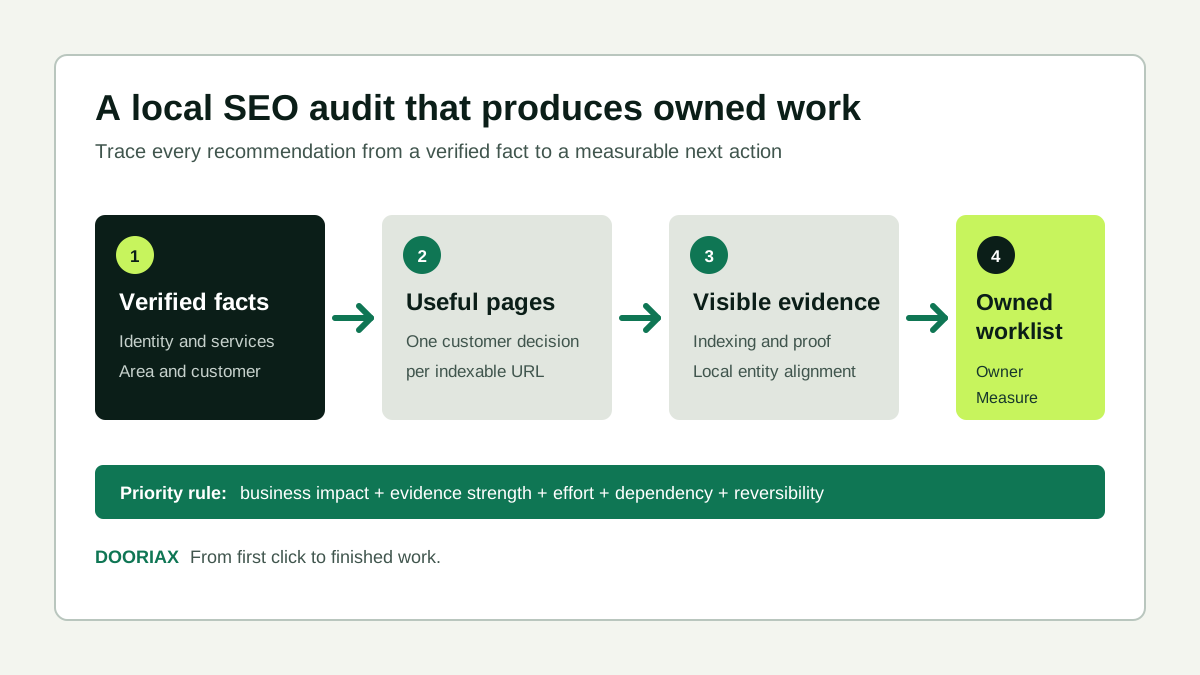
What should a local SEO audit deliver?
The deliverable should be a decision record, not a collection of screenshots. Each finding needs the affected URL or profile, the observed evidence, the customer or search risk, the recommended action, the responsible owner, and the measurement that will show whether the change helped.
| Finding | Evidence | Action | Success measure |
|---|---|---|---|
| Two pages serve the same search intent. | Overlapping titles, copy, queries, and internal links. | Choose the stronger page, consolidate useful information, and redirect the weaker URL. | One preferred URL is indexed and receives the relevant query impressions. |
| The Business Profile and website describe different services. | Profile categories and description conflict with the homepage and service pages. | Verify the real operating model, then align the public facts. | Customers see the same name, category, service, phone, website, and area. |
| Search traffic produces no known business outcome. | Clicks are recorded, but calls, forms, qualification, and completed work are not connected. | Define events and lead states, then pass outcome information back into reporting. | Qualified inquiries and completed outcomes can be reviewed by landing page and source. |
Start with a verified business facts ledger.
Before reviewing keywords, write down the facts the business can support today: public name, legal owner, primary category, services, service method, customer type, locations, service areas, phone, website, hours, licenses where required, booking process, and approved proof. Mark any uncertain field for confirmation instead of filling the gap with an assumption.
This ledger becomes the reference for the website, Google Business Profile, Bing Places, Apple Business Connect, social profiles, directories, structured data, and outreach. Perfect consistency is not about copying one block of text everywhere. It means every public source describes the same real entity without contradictory facts.
Do not turn the business name into a keyword field.
Google's Business Profile guidelines say the profile name should match the real-world name used on the website, stationery, storefront, and by customers. Services, location, and marketing language belong in their designated fields, not inside a keyword-stuffed business name.
Map one useful page to one customer decision.
List every indexable URL beside the question it answers and the next action it supports. A service page can explain a distinct service. A location page can explain a genuinely different market. An article can teach a decision that does not belong on the sales page. If two URLs perform the same job, the audit should recommend improvement, consolidation, or removal.
Use a page-purpose matrix.
| Page type | Customer question | Required evidence | Primary action |
|---|---|---|---|
| Homepage | What does this company do, for whom, and where? | Clear operating model, identity, service scope, and trust path. | Choose a service, call, book, or request an assessment. |
| Service page | Can this business solve this specific problem? | Process, eligibility, limitations, service area, proof, and expectations. | Request the matching service. |
| Location page | Does the business meaningfully serve this market? | Real service relationship, market-specific facts, and useful local detail. | Confirm availability or contact the local route. |
| Article | How should the reader understand or evaluate a decision? | Original analysis, primary sources, examples, and transparent authorship. | Continue to a related guide or relevant service. |
Do not create one page per keyword variation. Google's current AI Search guidance says its systems understand synonyms and related meaning, and warns against scaled pages created mainly to manipulate rankings.
Verify what search engines can actually retrieve.
Audit the rendered page and the server response. Important content should be public, readable, internally linked, and available without requiring a person to click through an application state. Search engines need one preferred address for each resource.
- Status: useful pages return 200, moved pages use permanent redirects, and missing pages return a real 404 or 410.
- Index controls: priority pages permit indexing and are not blocked by robots rules or accidental noindex directives.
- Canonical URL: the canonical, internal links, sitemap, redirects, and public hostname agree.
- Internal discovery: important pages are linked from relevant navigation, hubs, services, and articles with descriptive anchors.
- Mobile completeness: the mobile page contains the same essential copy, links, images, metadata, and structured data.
- Page experience: content appears quickly, layouts remain stable, text is readable, controls are labeled, and overlays do not obstruct the task.
Google notes that duplicate content is not automatically a spam violation, but it can confuse users and waste crawling resources. Redirect duplicate URLs when possible, or use a canonical when a redirect is not appropriate.
Replace marketing adjectives with evidence.
A service page needs enough detail to help a customer decide. Useful evidence can include the real process, diagnostic criteria, boundaries, prices when approved, staff credentials, current hours, original photography, verified reviews, documented project examples, safety guidance, and primary sources for technical claims.
Google's people-first guidance asks whether the content adds original information, provides substantial value, shows clear authorship, and demonstrates first-hand expertise. An audit should flag anonymous copy, unsupported superlatives, recycled advice, outdated claims, and pages whose only purpose appears to be attracting search traffic.
Record who, how, and why.
- Who: identify the person or organization responsible for the content and link to reliable background information.
- How: explain the method when testing, research, automation, or professional review materially shaped the article.
- Why: publish because the page helps the intended customer make a real decision, not because another keyword variation exists.
Audit the Google Business Profile as part of the same entity.
The profile is not a separate marketing experiment. Compare it with the facts ledger and website. Verify the exact public name, ownership and access, primary category, secondary categories, services, phone, website, hours, service area, address visibility, appointment links, photos, posts, questions, and review response process.
Google recommends using as few categories as possible, selecting categories that are specific and representative of the core business, and not using categories merely as keywords. A service-area business should hide its address when customers are not served there and should publish only an accurate service area.
Review quality before review quantity.
Do not manufacture reviews or script claims a customer did not make. Build a consistent request and response process for genuine customers. The audit should note review recency, service themes, unresolved complaints, owner responses, and whether the profile's review evidence matches the work the website promotes.
Treat AEO as clear, trustworthy SEO for Google.
Google says AI Overviews and AI Mode use its core Search ranking and quality systems. A page must be indexed and eligible to appear with a snippet before it can support these generative features. The audit should therefore fix content quality, crawlability, indexing, canonicalization, mobile delivery, local business details, and page experience before chasing AI-specific tactics.
Google also says llms.txt, special AI markup, artificial content chunking, separate AI rewrites, and inauthentic mentions do not improve visibility in Google Search. Dooriax maintains concise machine-readable context for other systems, but it does not present that file as a Google ranking signal.
Make important answers easy for people to find.
Use clear headings, direct paragraphs, useful tables, named sources, and complete answers because they improve reading and evaluation. Add accurate Article or BlogPosting structured data when it describes the visible page. Google recommends including applicable properties such as author, author URL, publication date, modification date, and representative images, but structured data does not guarantee a search feature.
Measure search as a path to qualified work.
Clicks are not leads, leads are not customers, and customers are not always profitable work. The audit should connect search visibility to the next verifiable business state without pretending one event proves another.
- Discovery: indexed pages, impressions, query themes, branded searches, AI impressions when reported, and profile visibility.
- Engagement: useful landing sessions, call clicks, booking starts, form starts, and directions when relevant.
- Qualification: service fit, location fit, contactability, timing, budget context, and genuine intent.
- Outcome: booked appointment, attended appointment, estimate, approved work, completed work, and value where the business can record it lawfully.
Use Search Console to review query and page trends, but allow time for changes. Google's SEO Starter Guide notes that some changes can appear in hours while others take several months, and no improvement guarantees a ranking change.
What changes across local service industries?
The audit framework stays stable, but the evidence and customer decision change by industry.
| Industry | Priority facts | Content risk to check |
|---|---|---|
| Restaurants | Current menu, prices, hours, reservations, ordering, dietary information, and location access. | Old menus, mismatched hours, duplicate delivery URLs, and stock photography replacing real dishes. |
| HVAC, plumbing, and electrical | Service types, emergency availability, licensed scope, coverage area, diagnostic process, and scheduling. | Unsupported safety claims, copied manufacturer language, and vague pages that hide the actual process. |
| Roofing, lawn care, and pest control | Property type, season, inspection or treatment process, recurring plans, preparation, and route coverage. | Thin city pages, invented local offices, unsupported guarantees, and no original project evidence. |
| Massage and wellness | Practitioner credentials, service format, duration, prices, booking, accessibility, and responsible boundaries. | Unsupported medical claims, hidden practitioner information, and unclear cancellation or booking expectations. |
Turn the audit into a 30-day worklist.
- Days 1 to 3: lock verified facts. Confirm identity, categories, services, locations, service area, contacts, hours, credentials, and approved evidence.
- Days 4 to 7: repair blockers. Fix status codes, noindex mistakes, canonical conflicts, broken internal links, mobile omissions, sitemap errors, and critical accessibility failures.
- Days 8 to 14: consolidate architecture. assign one customer decision to each priority URL, merge overlap, improve navigation, and preserve valuable signals with redirects.
- Days 15 to 21: strengthen proof. Add real process information, original images, visible authorship, primary sources, verified reviews, and responsible claim boundaries.
- Days 22 to 26: align local profiles. Update the Business Profile and other controlled profiles from the same facts ledger without keyword stuffing.
- Days 27 to 30: verify measurement. Test calls, forms, bookings, consent, source capture, qualification stages, Search Console access, and the reporting cadence.
Rank actions by expected customer impact, evidence strength, effort, dependency, and reversibility. Fix a blocked booking form before rewriting a title. Correct the wrong business category before publishing another article. Repair one valuable page before generating ten weak variations.
Common local SEO audit questions.
Does a high audit score guarantee rankings?
No. A score is a prioritization aid, not a Google metric. Search visibility depends on relevance, quality, competition, authority, location context, technical eligibility, and systems outside the audited website.
Should every service and city have a page?
Only when the page answers a distinct customer decision with accurate, useful, specific information. If the content, process, proof, and intent are substantially the same, a stronger regional or service page may be more useful.
Is local SEO different from AI search optimization?
For Google, the foundation is the same: valuable people-first content, crawlability, indexing, page experience, accurate business details, and honest measurement. There is no separate Google AI ranking file or hidden keyword layer.
How often should the audit be repeated?
Run focused checks after a redesign, domain move, profile change, major service change, tracking change, or unexpected performance shift. A broader quarterly review is reasonable when the business, site, and market change frequently.